


Grelha de Gravilha IBRAN — a escolha dos profissionais.
Capacidade de carga excecional e instalação rápida e simples. As grelhas de gravilha IBRAN®-X40 são a solução de referência para todas as aplicações de estabilização de solo: entradas de garagem em gravilha, parques de estacionamento, vias de acesso de emergência e outras superfícies reforçadas em gravilha.
Crie uma superfície robusta e cuidada, transitável por qualquer tipo de veículo. Fabricadas exclusivamente em plástico 100% reciclado (PP+HDPE), resistem a todas as condições climatéricas sem fragilizar.
Com mais de 100 000 instalações bem-sucedidas e mais de 10 anos de melhoria contínua, aperfeiçoámos as nossas grelhas de retenção de gravilha. Ao longo desse percurso, introduzimos paredes de célula nervuradas com 3,5 mm de espessura e uma nova base em retícula moldada em X que impede a migração dos inertes para baixo e mantém a base das paredes unida, evitando o colapso progressivo que ocorre quando uma parede cede a partir da base.
Associe as grelhas a um geotêxtil de enrolar, selecionado em função das características do terreno, para obter o sistema anti-migração de gravilha mais eficaz do mercado.
O resultado é um sistema de reforço de gravilha excepcionalmente eficaz, extremamente durável e simples de instalar. Empreiteiros em todo o mundo classificam-nas como as "melhores grelhas de gravilha em plástico que alguma vez utilizaram".
Em parques de estacionamento em gravilha, o sistema suporta as cargas por eixo equivalentes às de uma superfície ligada como betão ou asfalto (cargas por eixo de 25 toneladas). As grelhas IBRAN®-X40 melhoram a drenagem da superfície estabilizada, restituindo rapidamente a água pluvial ao solo e reduzindo o escoamento superficial.
Dimensão generosa (4 por metro quadrado / 3,7 por jarda quadrada) para uma instalação rápida e fácil, e dimensão contida para minimizar desperdícios. O sistema de grelhas permeáveis IBRAN torna os projetos de pavimentação drenante rápidos e economicamente eficientes, tanto em entradas residenciais como em aplicações comerciais de maior escala. Instaladas corretamente, as nossas grelhas de gravilha resistem ao longo do tempo.
São a solução ideal e ecológica para prevenir a migração de gravilha, mesmo em taludes até 25%.
- Totalmente permeáveis: solução eficaz de drenagem sustentável conforme os requisitos de gestão de águas pluviais em vigor
- Cobre grandes áreas rapidamente (500 x 500 x 40mm / 20 x 20 x 1.6in)
- Base em retícula X moldada: retém o agregado e fecha a estrutura celular sob carga
- Estabiliza agregado angular ou decorativo de 5-35mm (1/4in - 1 3/8in)
- Encaixe rápido por pressão, grelhas interligadas para instalação ágil
- Adequadas para automóveis, vans, veículos pesados e veículos de emergência com a sub-base adequada
- Fabricadas na Europa, em fábrica IBRAN, com materiais 100% reciclados de alta qualidade
- Estáveis aos UV e resistentes ao gelo (-50ºC a +90ºC / -58ºF a +194ºF)
- Cumpre os requisitos de acessibilidade para cadeiras de rodas aplicáveis
- Adequadas para uma vasta gama de aplicações domésticas e comerciais, de uso ligeiro a pesado
- Garantia de longa duração de 25 anos (sujeita a instalação documentada — consulte o guia de instalação)
Especificações completas abaixo.
Grelhas de Gravilha Specifications
| Dimensões: | 500mm x 500mm x 40mm |
| Cobertura por grelha: | 4 grelhas/m2 |
| Espessura da parede nervurada: | 3.5mm |
| Cor: | Preto (outras cores disponíveis sob consulta) |
| Espaço celular: | 68mm x 68mm quadrados |
| Peso: | 860g/grelha |
| Resistência à compressão: | 500 toneladas por m² (ensaio PLT) |
| Capacidade de carga por eixo: | 25 toneladas |
| Material: | 100% recycled PP/HDPE |
| Estabilidade térmica: | -50ºC to +90ºC |
| Enchimento recomendado: | 5-35mm Angular/Decorative Gravel |
| Ambiental: | Não tóxico, quimicamente inerte e reutilizável |
| Tolerância a declives: | 25% / 15º |
| Conformidade: | Drenagem sustentável de águas pluviais; acessível a cadeiras de rodas |
| Compatibilidade: | Seguro para raízes de árvores |
Documentação Técnica
Aceda a mais detalhes técnicos e especificações através dos links abaixo:
IBRAN-X 40mm Technical Data Sheet
Guia de dimensionamento da sub-base
Comparação de Pegada de Carbono
As grelhas de gravilha IBRAN-X estabilizam gravilha em qualquer obra.
A IBRAN-X é o sistema de grelha de gravilha plástica mais versátil e de uso intensivo do mercado. Com drenagem livre e capacidade de carga excecionalmente elevada (500 toneladas/metro quadrado), é suficientemente robusta para qualquer entrada em gravilha de baixo custo, caminho pedonal, via de acesso ou parque de estacionamento comercial e industrial.
Capacidade de carga excecional — até 500 toneladas por metro quadrado.
Com 500mm x 500mm x 40mm, é possível montar até 360m2 por hora, com desperdício e esforço mínimos. A estrutura de grelha leve (860g por painel, estabilizada aos UV com modificador de impacto) é reforçada com estabilizadores UV e um modificador de impacto que conferem uma durabilidade notável. E mais: são fabricadas de forma sustentável numa fábrica IBRAN na UE, com materiais 100% reciclados de alta qualidade.
Design cuidado, desenvolvido para profissionais.
Ao longo de mais de 10 anos, melhorámos continuamente o nosso sistema de grelha de gravilha, aperfeiçoando o design com base no feedback de profissionais da construção. Nesse período, apoiámos mais de 100 000 projetos com IBRAN-X. Os profissionais valorizam a IBRAN-X por:
- Instalação rápida — cobertura de grandes áreas com menos desperdício de cortes.
- Encaixe interligado — confere resistência para uso por veículos, mesmo em declive.
- Malha em X — impede a migração de pedras para baixo e evita o levantamento das grelhas.
- Modificado ao impacto — a nossa composição plástica inclui um aditivo que previne a fratura.
Instale em qualquer obra para criar parques de estacionamento acessíveis a cadeiras de rodas, vias de acesso para uso intensivo, entradas em gravilha e caminhos pedonais. As grelhas de estacionamento em gravilha IBRAN tornam a criação da entrada perfeita rápida e simples. A IBRAN-X pode ser preenchida com qualquer gravilha ou pedra rugosa ou lisa de 5-35mm, que assenta perfeitamente nas células da grelha.
Fabricadas de forma sustentável, com plásticos reciclados.
Superando os padrões do setor e desenvolvida a pensar nos profissionais, a IBRAN-X incorpora todas as características solicitadas pelos nossos clientes. Enquanto fabricante comprometido com a sustentabilidade, o nosso objetivo é produzir soluções que cumpram os mais elevados padrões de desempenho — porque um produto que não está à altura da função não é sustentável.
Em linha com os nossos objetivos de sustentabilidade, as grelhas têm a dimensão ideal para uma instalação rápida, sem necessidade de grandes aparas desperdiçadas. Poupa dinheiro e poupa o ambiente.
Qualidade superior a preço competitivo.
Somos um dos poucos fabricantes verdadeiramente integrados de grelhas de gravilha na Europa. Não importamos nenhum dos nossos produtos, incluindo as grelhas de estabilização de gravilha. Cada grelha de uso intensivo é fabricada internamente e expedida diretamente da nossa fábrica no prazo de 1 a 4 dias úteis após aprovação nos nossos controlos de qualidade.
Eliminar intermediários desnecessários é o que nos permite oferecer grelhas de gravilha de qualidade superior a um preço altamente competitivo.
Instale as grelhas de estacionamento IBRAN em qualquer local para uma qualidade duradoura.
Milhares de projetos bem-sucedidos até à data.
Poderíamos apresentar centenas de razões para escolher a IBRAN, mas acreditamos que a opinião dos nossos clientes fala por si.
Com mais de 10 anos de experiência e mais de 100 000 projetos concluídos com sucesso, temos a certeza de que vai gostar de trabalhar connosco.
Não fique apenas pela nossa palavra. Leia o que os nossos clientes têm a dizer.
What is IBRAN-X?
IBRAN-X is a high-strength permeable paving grid system designed for gravel retention and ground reinforcement. Made from PP (polypropylene) and HDPE (high-density polyethylene), it creates stable, permeable surfaces for driveways, parking areas, and many other applications.
The unique cell design prevents gravel migration while allowing natural drainage.
Can you cut gravel grids?
Most plastic gravel grids can be cut to fit any shape or size of area, with the offcuts usually able to be recycled.
The larger the grid, the larger the offcuts can be. The smaller the grid, the more labour is involved in installing them - especially if they are interlocking grids. Our design sits in the sweet spot.
500mm square grids are considered the gold standard, and as such our grid is designed to this specification.
What are the benefits of using IBRAN-X?
IBRAN-X gravel grids offer multiple benefits:
- Exceptional strength (tested to 500 tonnes per square metre)
- 100% permeability for SuDS compliance
- Minimal maintenance requirements
- Rapid installation using our interlocking system
- UV stability to prevent degradation
- Eco-friendly construction using recycled materials
- Prevents gravel migration
- Eliminates rutting
- Creates wheelchair-friendly surfaces when properly installed
What vehicles can drive on IBRAN-X Gravel Grids?
IBRAN-X has been independently tested to withstand loads of up to 500 tonnes per square metre, making it suitable for everything from domestic vehicles to heavy goods vehicles.
This makes it ideal for:
- Residential driveways
- Commercial parking lots
- Emergency access routes
- Industrial applications
What kind of stone should be used with IBRAN-X?
For optimal performance, we recommend using 20mm angular gravel with IBRAN-X grids. However, the system can accommodate aggregates between 5mm and 35mm.
Angular gravel is preferred over rounded as it locks together better, creating a more stable surface.
For driveways specifically, 20mm angular gravel provides the best balance of stability and drainage while being less likely to get caught in tire treads.
How are IBRAN-X grids installed?
Installation follows these key steps:
- Excavate to the required depth (typically 150-300mm depending on application)
- Install a geotextile membrane to prevent upward migration of sub-base materials
- Add and compact Type 1 or Type 3 sub-base to the required depth
- Add a thin laying course of 10-20mm sharp sand or granite dust
- Lay IBRAN-X grids, connecting them using the interlocking system
- Fill with chosen aggregate
For detailed instructions, please consult our installation guide.
Is there a guarantee with IBRAN-X?
Yes - provided you can provide evidence of having followed our installation guide, then we offer a 25 year guarantee.
Is IBRAN-X Gravel Grids SuDS Compliant?
Our gravel grids are 100% permeable, making them one of the best Sustainable Urban Drainage Solutions.
Is IBRAN-X Wheelchair Friendly?
In the UK, there are no documents or set standards for approval of our system except for the government's own guidance, known as Part M.
To be part M compliant, the surfacing choice needs to demonstrably smooth enough to allow a wheelchair user to manoeuvre their wheelchair, whilst supporting their weight.
Using IBRAN gravel grids is the only way to make a gravel surface suitable wheelchair friendly.
This video demonstrates the ease of wheelchair use: demonstration video.
Is IBRAN ISO-9001 certified?
Yes, ISO-9001 is just one of the many certifications we are proud to carry as a manufacturer.
What are gravel stabilisation grids?
Gravel stabilisation grids are a type of ground reinforcement system made from PP (polypropylene) and HDPE (high-density polyethylene). They are used to create a stable, permeable, and aesthetically pleasing surface for a variety of applications, including driveways, walkways, and landscaping.
The grids are made up of a series of interlocking cells that hold the gravel in place, preventing it from shifting and moving underfoot.
What are the benefits of using gravel stabilisation grids?
There are many benefits to using gravel stabilisation grids, including:
- Stability: By preventing the gravel from spreading, they ensure a consistently stable and level surface
- Permeability: By allowing the passage of water, they reduce runoff, which reduces flooding in built-up areas by allowing for natural drainage
- Durability: The combination of PP and HDPE materials creates a robust system that is resistant to rot, decay, and pests
- Aesthetics: Gravel stabilisation grids can be used to create a variety of different patterns and designs
- Low maintenance: Once installed, gravel stabilisation grids require very little maintenance
Can I use gravel stabilisation grids on all types of ground?
Gravel stabilisation grids can be used on a variety of different ground types, including clay, sand, and gravel. However, it is crucial to ensure that the ground is properly prepared with a stable, compacted sub-base before installation. This foundation work is essential for the long-term performance of the system.
How long do gravel stabilisation grids last?
Gravel stabilisation grids made from PP and HDPE materials are extremely durable and can last for many years. However, the lifespan of the grid will depend on:
- The specific application
- The quality of installation and sub-base preparation
- The amount of traffic it receives
Do I need planning permission to install gravel stabilisation grids?
In most cases, you will not need planning permission to install gravel stabilisation grids. However, it is always best to check with your local planning authority to be sure.
How much do gravel stabilisation grids cost?
The cost of gravel stabilisation grids will vary depending on the size of the area you need to cover and the specific type of grid you choose. However, they are generally a cost-effective solution for creating a stable and durable gravel surface.
Additional Applications & Suggested Uses
Our versatile product can support a much wider range of applications.
Eco-friendly, sustainable grass and gravel paving and structural support solutions.
- Ground stability grids installed at ground level to prevent soil disruption from vehicle and foot traffic.
- Access roads and emergency service lanes (e.g., fire and ambulance routes)
- Driveway grids and gravel parking
- Grass or gravel car parks, including temporary and permanent overflow parking Reinforcement for residential driveways, lawns, and gravel parking
- Surface drainage solutions for stormwater management and flood control
- Safe water runoff solutions and French drains Stability for railway embankments
- Slope and embankment reinforcement
- Drainage and melioration ditches
- Use for horse paddocks, ménages, and arenas
- Buggy paths and disability access routes
- Golf course pathways and grass stabilisation
- School play areas and access routes
- Flooring for events and marquees
- Lawn protection for sloped gardens
What is the difference between a moulded mesh base and a heat-welded membrane?
A moulded mesh base is formed as part of the grid in a single moulding operation, so it is structurally integral to the cell walls. A heat-welded membrane is a separate sheet of fabric bonded to the underside of the grid after moulding.
The distinction matters for two reasons:
- Retention: a moulded mesh physically arrests downward migration of aggregate into the sub-base, and cannot delaminate or tear away, because it is the same piece of material as the grid.
- Structure: the mesh ties the base of every cell wall to its neighbours, resisting the tendency of cells to splay open under vertical load and under torsional loading from steering, braking and turning vehicles.
A bonded fabric contributes nothing to the structural performance of the grid. It is a filtration layer, not a reinforcement.
Does a heat-welded membrane stop gravel migrating downwards?
Only while it remains intact.
A thin non-woven fabric bonded to the underside of a grid will suppress weed growth and will initially hold back fines. The problem is where it sits: directly beneath the aggregate it is meant to retain.
Angular gravel is the aggregate specified for almost every stabilised gravel application, and angular gravel has sharp arrises. Under repeated point loading from vehicle traffic, those arrises work against a lightweight fabric until it is punctured. Once punctured, the membrane no longer performs the retention function and aggregate begins to migrate into the laying course and sub-base.
A moulded mesh base does not share this failure mode. It is rigid moulded polymer, not a fabric skin.
Does the mesh base do anything other than retain gravel?
Yes, and this is the part most specifiers overlook.
The cell walls of any gravel grid are, in effect, a honeycomb of thin vertical webs. Loaded vertically, and particularly loaded torsionally when a vehicle turns on the spot or brakes hard, those webs want to deflect outwards at their base. Once cells begin to splay, the grid loses its confining effect on the aggregate and the surface starts to rut and spread.
A moulded mesh base restrains the foot of every cell wall, holding the geometry closed and transferring load laterally across the panel rather than into individual webs.
Load performance and cell base design cannot be considered separately.
Do I still need a separate membrane if my grid has a mesh base?
We recommend using both. They are not doing the same job.
- The moulded mesh base retains aggregate and closes the cell structure, at surface level.
- A geotextile membrane laid at formation level, beneath the sub-base, prevents upward migration of subgrade fines into the granular layers and provides separation and, depending on grade, reinforcement.
Two different functions, at two different levels in the build-up. Combining a mesh-based grid with a correctly specified geotextile gives you retention at the surface and separation at formation.
Relying on a single bonded fabric to do both is a compromise driven by convenience rather than engineering.
Will a membrane-backed grid save me time on installation?
Marginally, and it is worth being honest about the scale of the saving.
Rolling out geotextile across a prepared formation is one of the quickest tasks in the entire installation. On a typical domestic driveway it is a matter of minutes.
Set that against the consequence of specifying the wrong separation layer, or of a bonded fabric failing in service. Excavating and relaying a failed driveway is measured in days and in thousands of pounds.
Choosing the membrane grade to suit the subgrade, the traffic and the drainage strategy is a decision worth making deliberately, at formation level, rather than having it made for you at the factory.
Why does IBRAN not bond a membrane to the underside of its grids?
Because it would substitute a consumable fabric for a structural feature.
Our grids are moulded with an integral mesh base that performs the retention function permanently and contributes to the load and torsional performance of the panel. Bonding a fabric on top of that would:
- Add cost
- Add a component with a shorter service life than the grid itself
- Remove the installer's ability to specify the right geotextile for the ground conditions they are actually dealing with
We would rather give you a grid that does not depend on a fabric, and let you choose the membrane the project needs.
Haili Branson
OnlineA Escolha dos Líderes do Setor


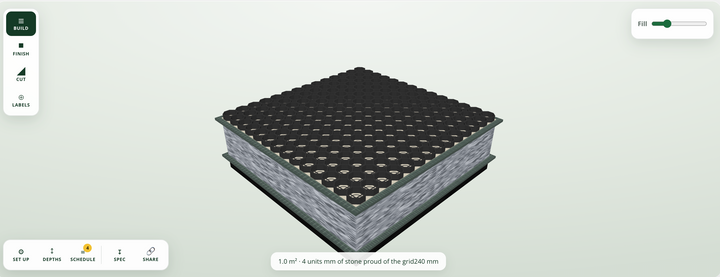
Construa a sua especificação técnica
Defina a área, escolha a grelha e o material de enchimento, e visualize o acabamento final. As quantidades e a especificação completa são geradas automaticamente.
- Quantidades e pesos para a composição completa do pavimento
- Profundidade da sub-base por classe de tráfego
- Adicione as grelhas diretamente ao carrinho

Por que as Grelhas de Gravilha IBRAN São a Escolha Certa para Profissionais
Quando o seu nome está associado à obra, cada material que utiliza reflete o seu nível de exigência. É por isso que profissionais da construção em toda a Europa confiam na IBRAN — as nossas grelhas de gravilha são concebidas para superar as alternativas mais volumosas que prometem poupar tempo, mas raramente resistem às condições reais de obra.
Ao contrário das grelhas de grandes dimensões com manta geotêxtil incorporada, que cedem sob carga e geram desperdício com recortes difíceis e uniões frágeis, a IBRAN oferece uma solução profissional pensada para rapidez, resistência e zero compromissos:
- Formato compacto e modular para manuseamento mais rápido, corte mais fácil e menos desperdício em obra. Sem painéis de 2 m difíceis de manobrar nem tiras de recorte para o lixo — apenas cobertura eficiente sem plástico em excesso.
- Base em malha cruzada que fixa a gravilha no lugar, impedindo a migração da pedra por baixo e eliminando o levantamento — algo que as mantas geotêxteis simplesmente não conseguem garantir quando perfuradas pelo agregado ou assentadas de forma irregular.
- Polipropileno 100% reciclado com modificação de impacto resiste a fissuras, roturas e fragilidade pelo frio — muito mais durável do que células em favo de abelha com paredes verticais finas e têxteis não estruturais.
- Encaixe por pressão a partir de cima para instalação rápida — coloque centenas de metros quadrados por hora, sozinho ou em equipa, com interligação imediata e preparação mínima.
- Totalmente compatível com remates e acessórios IBRAN, para avançar da preparação ao acabamento sem atrasos, soluções alternativas ou sistemas incompatíveis.
As grelhas IBRAN não são sobredimensionadas para impressionar: são construídas com inteligência para instalar mais depressa, obter acabamentos mais rigorosos e reduzir as intervenções pós-obra. E porque não existe manta frágil cosida à base, o que assentar fica no lugar.
Instale uma vez. Sem deformações, sem complicações, sem falhas.
Soluções Sustentáveis
As grelhas de gravilha IBRAN combinam facilidade de instalação e versatilidade com um desempenho ambiental sólido. Fabricadas na UE a partir de polímeros 100% reciclados, contribuem para o confinamento permanente de resíduos plásticos e para a redução da pegada de carbono tanto na produção como no transporte.
Outros benefícios relevantes:
Controlo da erosão: Ao promover a estabilização de solo, as grelhas de gravilha para entradas de garagem e caminhos travam a erosão causada por chuvas intensas, protegendo a vegetação e as áreas envolventes.
Gestão de águas pluviais: As grelhas de gravilha permitem a infiltração da água da chuva através da superfície, contribuindo para a prevenção de cheias e para a recarga dos aquíferos — em linha com os requisitos de drenagem urbana sustentável exigidos pelos regulamentos de ordenamento do território.
Redução do calor superficial: Ao contrário dos pavimentos impermeáveis tradicionais, as grelhas de gravilha ajudam a baixar as temperaturas à superfície, contribuindo para ambientes urbanos mais frescos.


Instalação Simples
As grelhas de gravilha IBRAN são de instalação rápida e simples. As camadas porosas interligam-se entre si para reter todo o tipo de pedra (10 - 30mm). Podem ser aplicadas em qualquer superfície nivelada, mesmo com declives até 25%.
- Coloque as grelhas sobre uma sub-base granular bem compactada (tout-venant ou equivalente) ou qualquer superfície firme e regular.
- Regularize a sub-base com uma camada de areia grossa, coberta com geotêxtil permeável.
- Interligue as grelhas e preencha-as com pedra a granel.
Este sistema mantém as grelhas e a gravilha no lugar, criando uma superfície sólida e sem rodeiras, adequada à circulação de veículos.
As grelhas de gravilha em plástico reciclado IBRAN têm uma vida útil prevista superior a 25 anos, com manutenção mínima.


